


The Complete Guide to Fixing Loose Skin After Weight Loss
Why Does Loose Skin Occur After Significant Weight Loss?
To understand why skin remains loose after a major weight loss journey, we must look beneath the surface at the complex architectural layers of the dermis. Skin is not merely a passive, elastic sheet; it is a living organ designed to expand and contract in response to changes in body volume. However, its capacity to snap back is governed by a delicate network of structural proteins—primarily collagen and elastin—located within the middle layer of the skin (the dermis).
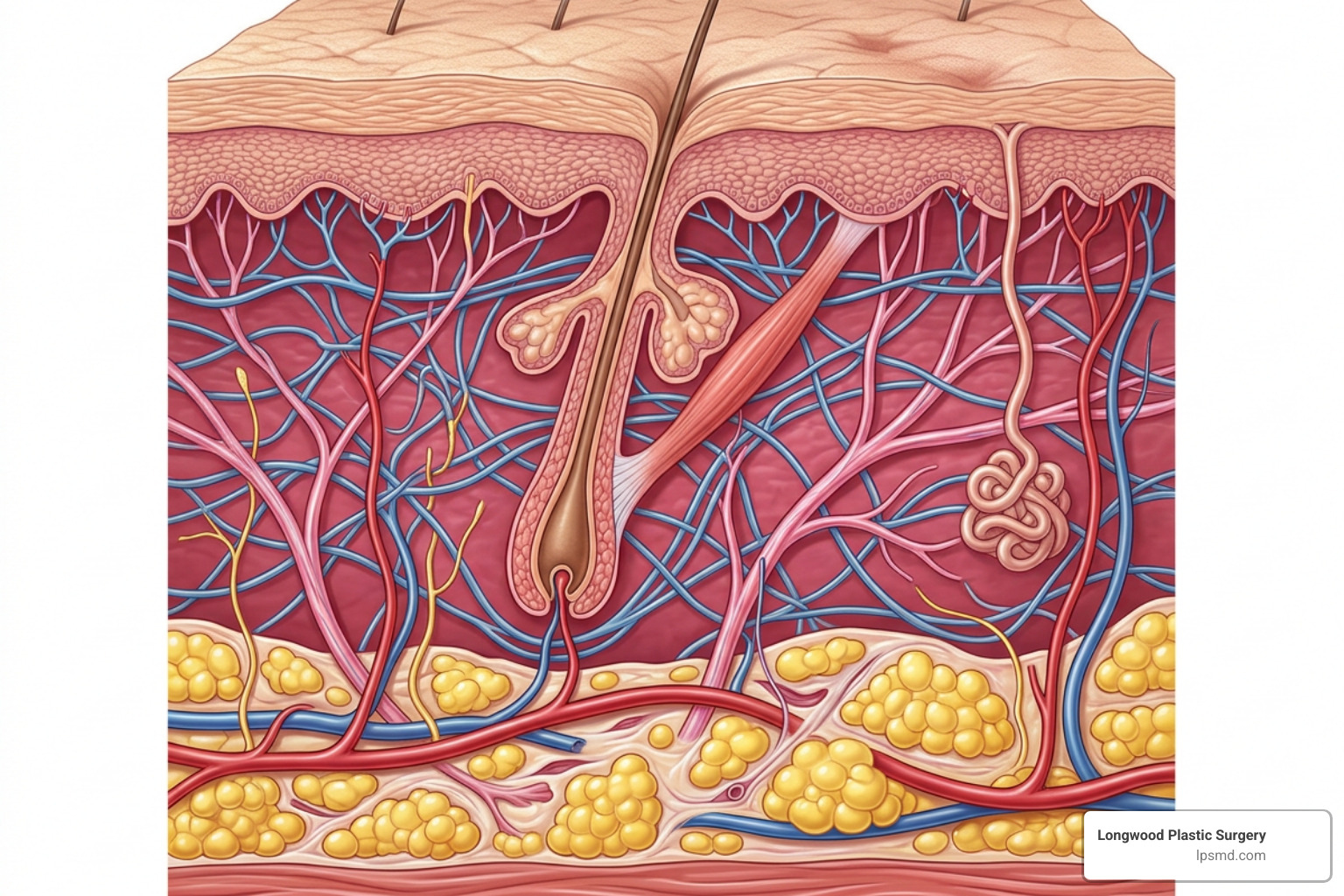
When weight gain occurs, the skin stretches to accommodate the expanding subcutaneous fat deposits. If this stretching is sustained over a prolonged period, the mechanical tension damages the underlying dermal architecture. Collagen fibers, which provide structural strength and thickness, become stretched, thinned, and misaligned. Simultaneously, elastin fibers, which allow the skin to bounce back after being stretched, lose their natural elasticity and fragment.
Losing over 50 to 100 pounds makes redundant skin almost inevitable. When a large volume of fat is lost rapidly, the deflated skin is left without a structural support system. Scientific research on skin changes after massive weight loss confirms that the skin of patients who have undergone massive weight loss is histologically weak. Microscopic analyses reveal a lower density and thickness of collagen fibers in the reticular dermis, alongside a near-total destruction of the elastic fiber network in the papillary dermis.
Furthermore, the duration of obesity plays a critical role in the skin’s structural memory. The longer the dermal tissues have been subjected to high-tension stretching, the more permanent the remodeling of the collagen matrix becomes. Once these structural proteins are degraded and disorganized, the skin loses its inherent “memory” of its original, smaller shape.
What does the science say about skin tensile strength?
Biomechanical testing provides objective proof of this structural degradation. In clinical studies comparing different patient populations, the ultimate tensile strength (UTS)—which measures the maximum stress a tissue can withstand before tearing—drops dramatically in post-massive weight loss skin:
- Normal Weight Skin: ~23.93 MPa
- Morbidly Obese Skin: ~24.98 MPa
- Post-Massive Weight Loss Skin: 13.31 MPa
This represents a near-50% reduction in structural integrity. Under microscopic analysis, the collagen fibers of patients with massive weight loss exhibit a characteristic “moth-eaten” appearance, showing a loss of fibrillary content and areas of homogenous color where healthy fibers should be. Because adult skin has a highly limited capacity to regenerate functional elastin fibers, this damaged dermal framework cannot be repaired by lifestyle changes, hydration, or topical treatments alone.
What Are the Main Risk Factors for Developing Saggy Skin?
While almost everyone experiences some degree of skin laxity after a major health transformation, the severity of redundant tissue is highly predictable. Clinical research shows that patients with all three of the following primary risk factors face a 91% rate of excess skin:
- Losing more than 100 pounds (the strongest predictor of severe laxity)
- Age over 40 (due to natural declines in cellular regeneration)
- A rapid rate of weight loss (greater than 2 pounds per week)
Conversely, patients with none of these risk factors have only a 12% rate of noticeable loose skin.
Beyond these primary metrics, several other biological and lifestyle variables dictate how well your skin will adapt:
- Genetics: Your DNA determines your baseline production of collagen and elastin, as well as how your skin responds to mechanical stress. Some individuals naturally possess more resilient dermal structures.
- Smoking: Nicotine is highly damaging to skin health. Smoking reduces collagen synthesis by 18% to 22% and doubles the activity of matrix metalloproteinases (MMPs), which are enzymes that actively chew up and destroy healthy collagen.
- Sun Exposure: Chronic ultraviolet (UV) radiation damages fibroblasts—the cells responsible for producing collagen and elastin. Daily sun protection is one of the most effective ways to preserve your skin’s natural elastic reserve over your lifetime.
For those currently planning or undergoing a body transformation, incorporating expert tips on avoiding saggy skin during weight loss can help mitigate these risks before the structural damage becomes permanent.
How does the rate of weight loss affect skin laxity?
The speed at which you lose weight is one of the few highly modifiable risk factors in your journey. Clinical data reveals that rapid weight loss (losing 3 or more pounds per week) results in 3.2 times higher rates of excess skin compared to gradual weight loss (losing 1.5 pounds per week).
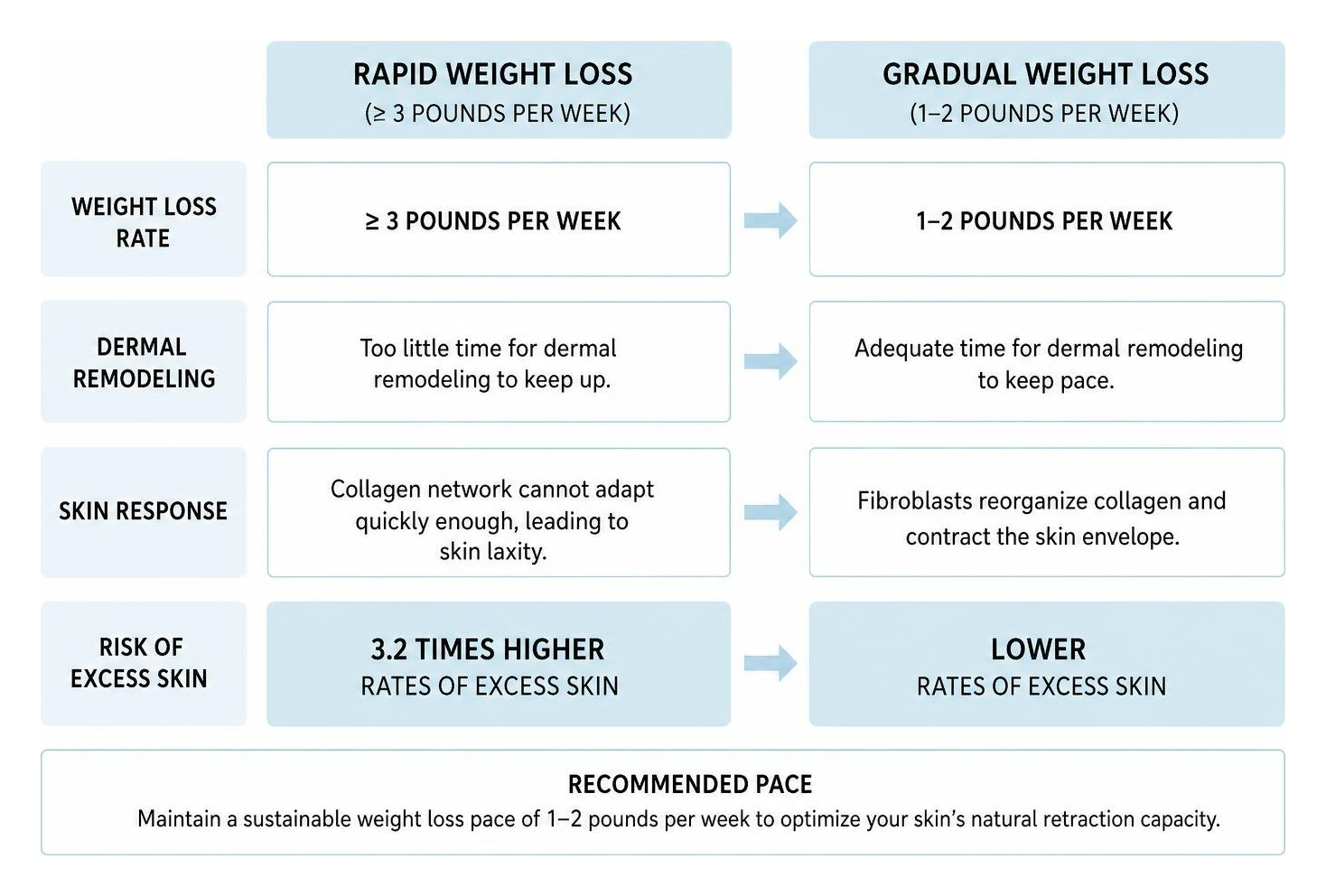
Physiologically, gradual fat reduction allows the dermal remodeling process to keep pace with your changing body contours. When fat is lost slowly, fibroblasts have the necessary time to reorganize the existing collagen matrix and slowly contract the skin envelope. To optimize your skin’s natural retraction capacity, we recommend maintaining a sustainable weight loss pace of 1 to 2 pounds per week.
Can You Tighten Loose Skin Naturally Without Surgery?
If you search the internet for solutions, you will find endless marketing claims for firming creams, special hydration protocols, and expensive supplements. However, it is essential to separate evidence-based science from commercial folklore.
First, let us debunk a common myth: drinking excess water and applying over-the-counter firming creams do not restore degraded dermal architecture. While hydration is vital for overall health, skin turgor is determined by the structural proteins in the dermis, not your daily water intake. Similarly, standard “firming” creams contain molecules that are far too large to penetrate the basement membrane of the skin; they merely sit on the surface, temporarily hydrating the epidermis to give a fleeting illusion of tightness.
To support natural skin remodeling, you must focus on systemic, evidence-backed interventions:
- High Protein Intake: Consuming 1.2 to 1.6 grams of protein per kilogram of body weight daily is critical. This provides the essential amino acid building blocks (such as proline, glycine, and lysine) that your body needs to synthesize new collagen while preserving lean muscle mass during a caloric deficit.
- Collagen Peptides: Clinical meta-analyses show that supplementing with 10 to 15 grams of hydrolyzed collagen peptides daily, combined with Vitamin C, can yield modest (7% to 12%) improvements in skin elasticity over 8 to 12 weeks. However, these peptides only work effectively when your body receives a physical signal that tells it where to rebuild.
To maximize these natural interventions, patients can follow targeted evidence-based protocols for natural skin tightening to support their body’s recovery.
Why is resistance training the most effective non-surgical tool?
The single most powerful non-surgical tool for improving the appearance of loose skin is progressive resistance training. While exercise cannot rebuild degraded elastin fibers, it solves the “deflation” problem by replacing lost fat volume with firm, active muscle tissue.
When you perform strength training 3 to 4 times per week using compound movements (such as squats, chest presses, and rows), you stimulate muscle hypertrophy. This newly built muscle physically fills out the loose skin envelope from beneath, creating a smoother, tighter, and more toned aesthetic.
Furthermore, resistance training has a direct biological effect on the skin itself. The mechanical tension and stretching of the skin during heavy lifting send signals to dermal fibroblasts, prompting them to increase collagen synthesis. Clinical studies have shown that consistent resistance training can increase dermal thickness by up to 12% in actively trained areas compared to just 2% in untrained areas.
What topical treatments actually penetrate the dermis?
While standard cosmetic creams fail to work, certain medical-grade topical therapies do cross the epidermal barrier to stimulate cellular change:
- Prescription Retinoids (Tretinoin 0.05% to 0.1%): Tretinoin is clinically proven to accelerate cell turnover, stimulate blood flow, and prompt fibroblasts to synthesize new collagen. When applied consistently for 6 months or longer, it can increase dermal thickness by roughly 8%, making it highly effective for mild skin laxity on the face, neck, or upper arms.
- Microneedling: This minimally invasive clinical treatment uses tiny, sterile needles to create controlled micro-injuries in the skin. This triggers the body’s natural wound-healing cascade, resulting in a surge of localized collagen and elastin production.
Combining professional microneedling treatments with a consistent, prescription-strength home skincare regimen represents the gold standard for treating mild to moderate skin laxity without undergoing surgery.
Do GLP-1 Medications Like Semaglutide Increase the Risk of Loose Skin?
The rapid rise of GLP-1 receptor agonists—such as semaglutide (Ozempic, Wegovy) and tirzepatide (Mounjaro, Zepbound)—has transformed modern weight management. These medications are incredibly effective, helping patients lose an average of 15% to 20% of their body weight over a 12-to-18-month period.
However, this rapid success has brought a highly visible side effect to the forefront: the “Ozempic Body” or “Ozempic Face.” These terms refer to the pronounced skin sagging and hollowed facial appearance that can occur when a large volume of subcutaneous fat is lost very quickly.
Does the medication itself damage your skin? No. GLP-1 medications do not directly harm collagen or elastin. Instead, the loose skin is a direct consequence of the speed and magnitude of the weight loss. Because patients on these medications lose fat at a highly accelerated rate, the skin’s natural, slow remodeling process simply cannot keep pace with the rapidly shrinking body volume. Clinical observations indicate that 23% to 31% of GLP-1 patients report noticeable, bothersome loose skin as they reach their goal weight, compared to much lower rates in those losing weight through traditional, slower lifestyle modifications. Learn more about how weight loss medications affect skin elasticity.
How can GLP-1 patients mitigate loose skin risks?
If you are currently taking or planning to start a GLP-1 medication, you can take proactive steps to protect your skin’s structural integrity:
- Start Resistance Training on Day One: Do not wait until you have lost the weight to start lifting. Incorporating progressive strength training from the very first week of your medication titration is essential to preserve your lean muscle mass and prevent severe skin deflation.
- Prioritize Protein: GLP-1 medications work by suppressing appetite, which often leads patients to drastically under-eat. You must consciously focus on consuming adequate protein (1.2 to 1.6 g/kg/day) to give your skin the raw materials it needs to repair itself.
- Advocate for Gradual Titration: Work closely with your prescribing physician to titrate your medication dose slowly. Aiming for a steady, controlled weight loss of 1 to 2 pounds per week—rather than rapid, double-digit monthly drops—will give your skin the best possible chance to contract naturally.
For patients who have already achieved their goal weight using these medications and are now navigating the resulting skin laxity, exploring specialized post-semaglutide body contouring options can help restore a firm, natural contour.
When Is Surgical Skin Removal the Only Effective Option?
While natural methods, strength training, and non-surgical treatments are excellent for mild to moderate skin laxity, they have biological limits. Once you have lost 80 to 100+ pounds, or if you are over the age of 45 and have experienced significant weight loss, the structural proteins in your skin have been permanently stretched and damaged. At this stage, no amount of exercise, protein, or laser treatments can physically shrink the large aprons of redundant skin.

When excess skin interferes with your physical comfort, makes exercise difficult, or causes chronic skin irritation, surgical skin removal becomes the only definitive, highly effective solution.
It is important to understand the key differences between the primary surgical procedures:
- Panniculectomy: This is a functional, reconstructive procedure designed solely to remove the hanging “apron” of skin and fat (the panniculus) from the lower abdomen. It does not tighten the abdominal muscles or reposition the belly button.
- Abdominoplasty (Tummy Tuck): This is a comprehensive cosmetic and structural procedure. It removes excess skin and fat, tightens the underlying abdominal wall muscles that may have stretched or separated (diastasis recti), and beautifully repositions the belly button for a flat, contoured midsection.
- Circumferential Body Lift: Often recommended after massive weight loss, this procedure extends a tummy tuck 360 degrees around the waist, lifting and tightening the abdomen, outer thighs, hips, and buttocks in a single surgery.
- Specialized Lifts: Other targeted procedures include a Brachioplasty (Arm Lift) to remove “batwing” skin, a Thigh Lift to contour the inner and outer thighs, and a Breast Lift (Mastopexy) to restore a youthful shape and position to deflated breast tissue.
To explore how these procedures can be combined or staged to fit your unique anatomy, you can read more about our comprehensive post-weight loss body contouring options.
What are the typical costs, recovery timelines, and insurance considerations?
Surgical skin removal is a major life milestone that requires careful financial and logistical planning. Below is an overview of what patients can typically expect:
| Procedure | Typical Recovery Time | Common Insurance Status | Primary Focus |
|---|---|---|---|
| Panniculectomy | 2 to 4 weeks off work | Often covered (if medical criteria are met) | Functional removal of hanging lower abdominal skin |
| Abdominoplasty (Tummy Tuck) | 2 to 4 weeks off work | Rarely covered (considered cosmetic) | Aesthetic contouring, skin removal, and muscle tightening |
| Circumferential Body Lift | 4 to 6 weeks off work | Rarely covered (considered cosmetic) | 360-degree tightening of abdomen, hips, and buttocks |
| Brachioplasty (Arm Lift) | 2 weeks off work | Rarely covered (considered cosmetic) | Removal of loose skin from the underarms |
| Thigh Lift | 3 to 4 weeks off work | Rarely covered (considered cosmetic) | Tightening and smoothing of the inner/outer thighs |
| Breast Lift (Mastopexy) | 1 to 2 weeks off work | Rarely covered (unless post-mastectomy) | Lifting and reshaping deflated breast tissue |
Insurance coverage for these procedures is highly specific. Most insurance companies will cover a panniculectomy if you meet strict medical necessity criteria, such as documenting chronic, recurrent skin infections (intertrigo), severe rashes, or skin breakdown within the folds that has failed to resolve with prescription topical treatments for at least 3 to 6 months. However, they will almost never cover an abdominoplasty or other body lifts, as these are classified as cosmetic.
Because post-massive-weight-loss surgery requires specialized techniques to safely manage altered tissue planes and blood supply, it is vital to choose board-certified plastic surgeons with experience in reconstructive body contouring, such as our team at Longwood Plastic Surgery in Brookline, MA. If you are ready to take the next step, you can find more detailed information about scheduling skin removal surgery with us.
Frequently Asked Questions About Loose Skin
How long does it take for skin to tighten naturally after reaching a stable weight?
Skin retraction is a slow, biological process that follows a logarithmic curve. Once you reach your goal weight and maintain a stable weight, your skin does not stop adapting immediately.
- First 6 Months: This is the most active phase, where roughly 68% of your natural skin retraction occurs.
- 6 to 18 Months: The remodeling process continues at a slower pace, with 87% to 94% of total retraction complete by month 18.
- 18 to 24 Months: By the two-year mark, 97% of your skin’s natural capacity to snap back is complete.
Because of this timeline, we strongly advise patients to wait at least 12 to 18 months of stable weight maintenance before scheduling any major skin removal surgery. This ensures your body has finished its natural healing process, which optimizes your surgical safety and long-term aesthetic results. For more guidance on managing this transition, read our clinical advice on how to tighten loose skin.
Does drinking water or taking collagen supplements actually work?
While these are highly popular remedies, their direct impact on moderate-to-severe loose skin is minimal:
- Drinking Water: Staying hydrated is essential for general cellular health and temporary skin plumpness (turgor). However, drinking excess water cannot rebuild a broken collagen matrix or repair fragmented elastin fibers. Once skin is structurally stretched out, hydration alone will not make it shrink.
- Collagen Supplements: When you swallow collagen powder, your digestive system breaks it down into basic amino acids just like any other protein source (such as chicken or eggs). Your body does not automatically send those amino acids to your loose skin. However, combining 10 to 15 grams of collagen peptides with a consistent resistance training program provides a localized “demand signal,” which can modestly support new dermal collagen synthesis.
How do I know if my abdominal tissue is loose skin or stubborn fat?
It can be difficult to tell whether your remaining abdominal volume is purely loose, empty skin or stubborn, resistant subcutaneous fat. You can perform a simple “pinch test” to help distinguish between the two:
- Loose Skin: If you pinch the area and the fold is very thin (typically under 1 inch or the thickness of a coin), you are dealing primarily with empty, redundant skin.
- Stubborn Fat: If the pinched tissue feels thick, firm, and dense (greater than 1 to 2 inches), there is still a significant layer of subcutaneous fat beneath the skin.
If you still have stubborn fat deposits, we recommend continuing your weight loss or stabilization journey, as surgical skin removal is safest and most successful when you are close to your target weight. In cases where stubborn fat and loose skin coexist, we can combine procedures like liposuction with surgical skin removal to sculpt a refined contour. Learn more about our approach to liposuction and body contouring.
Finding Your Path Forward
Losing a significant amount of weight is a life-changing achievement that dramatically improves your cardiovascular health, joint mobility, and overall longevity. Experiencing loose skin is not a failure—it is a normal, physical marker of the incredible journey your body has traveled.
As you navigate this next phase, we recommend a tiered, patient approach:
- The Stabilization Phase: Focus on maintaining a stable weight for 12 to 18 months.
- The Natural Foundation: Build muscle through consistent resistance training, maintain a high-protein diet, and protect your skin from sun damage.
- The Clinical Assessment: If redundant skin continues to cause physical discomfort or stands in the way of you fully enjoying your new body, seek professional guidance.
At Longwood Plastic Surgery, our board-certified plastic surgeons have over 50 years of combined experience helping patients in Brookline, Boston, and the greater Boston area complete their transformations. We provide personalized, safe, and entirely judgment-free care. Whether you are interested in non-surgical skin tightening or advanced post-weight-loss body contouring, we are here to support you.
Ready to explore your options? We invite you to schedule a private consultation at our Brookline office by visiting our Post-Weight Loss Body Contouring Page. Let us help you take the final step in your journey with confidence.


