


All About Breast Reconstruction Surgery Options
Understanding Breast Reconstruction Surgery: Options, Timing, and Candidacy
Breast reconstruction surgery is a surgical procedure that rebuilds the shape, volume, and contour of one or both breasts following a mastectomy or lumpectomy. Core options include prosthetic methods (saline or silicone implants) and autologous tissue transfers (using tissue from the abdomen, back, or thighs), performed either immediately during cancer surgery or delayed until after adjuvant treatments. Understanding what is breast reconstruction helps patients evaluate their choices with clarity, confidence, and peace of mind.
Breast cancer remains the most diagnosed cancer and the second leading cause of cancer death among women in the United States (Regan & Casaubon, 2023). Candidacy for reconstruction encompasses individuals undergoing mastectomy for active breast cancer, those carrying certain inherited gene changes (such as BRCA1 or BRCA2) undergoing preventive mastectomies, and select patients with significant contour changes after lumpectomy and radiation. As outlined in a comprehensive clinical overview of breast reconstruction, the decision to rebuild a breast is entirely personal. A patient may opt for implant-based reconstruction, autologous tissue reconstruction, or choose an aesthetic flat closure without rebuilding breast mounds.
Every reconstruction journey starts with shared decision-making. At Longwood Plastic Surgery, we work closely alongside your breast surgical oncologist and medical oncology team to determine an approach aligned with your oncologic safety, personal anatomy, and lifestyle goals.
Immediate vs. Delayed Surgical Timing
The timing of breast reconstruction surgery falls into two primary categories: immediate reconstruction and delayed reconstruction.
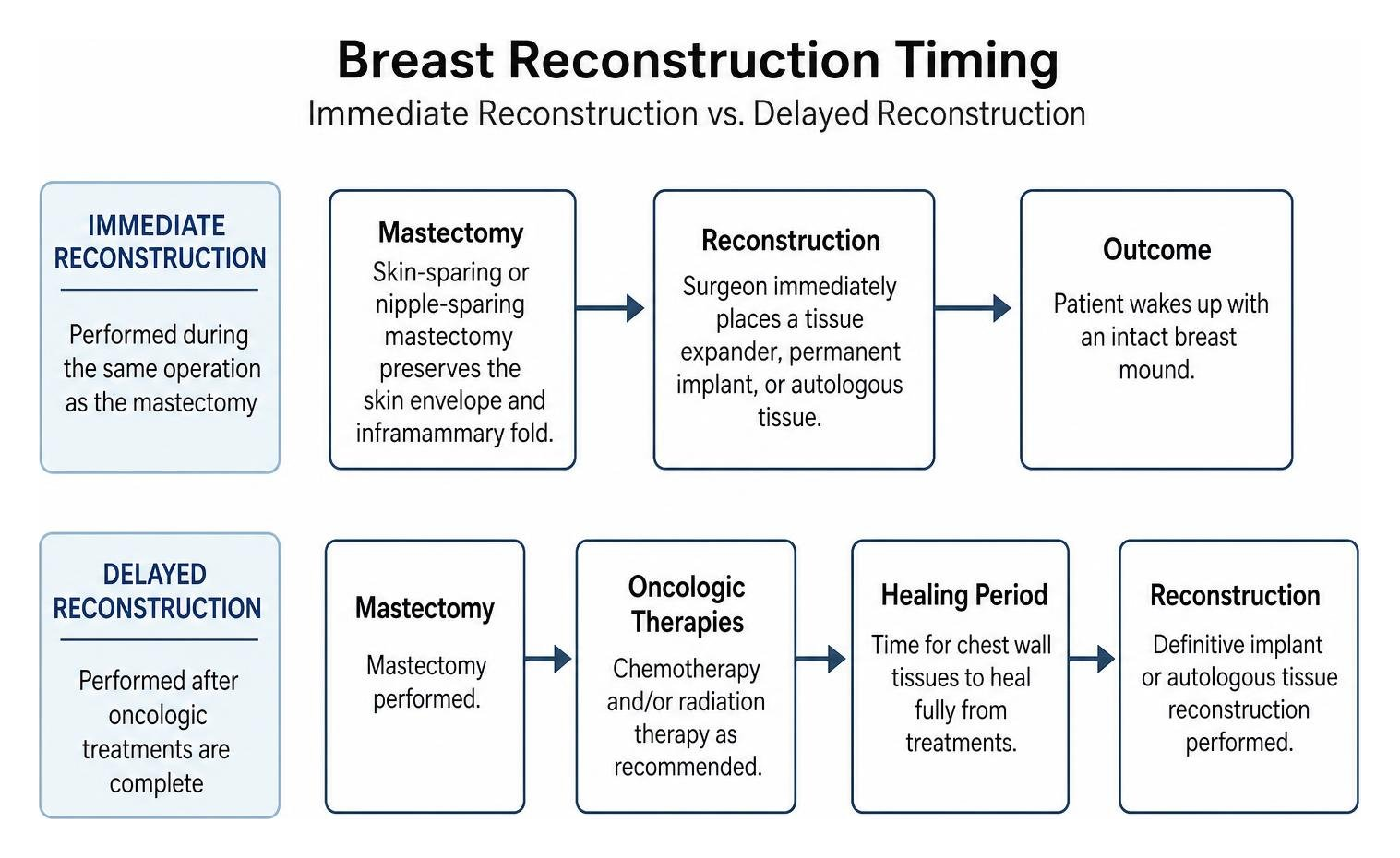
- Immediate Reconstruction: Performed during the exact same operation as the mastectomy. When oncologically safe, the breast surgeon performs a skin-sparing or nipple-sparing mastectomy, preserving the natural skin envelope and inframammary fold. The reconstructive surgeon immediately places either a tissue expander, a permanent breast implant, or autologous tissue. This pathway preserves natural skin elasticity and allows patients to wake up with an intact breast mound.
- Delayed Reconstruction: Performed months or even years after oncologic treatments are complete. This approach is frequently recommended for patients who require post-mastectomy radiation therapy, those with advanced-stage tumors, or individuals who prefer time to process their cancer diagnosis before deciding on reconstruction. Delayed reconstruction allows the chest wall tissues to heal fully from chemotherapy and radiation.
- Delayed-Immediate Reconstruction: In this hybrid method, a temporary tissue expander is placed at the time of mastectomy to preserve the skin pocket, but definitive flap or implant placement is deferred until after post-operative radiation is completed.
Understanding the foundational principles of reconstructive surgery allows our team to tailor your timeline so that cancer treatment is never compromised while achieving the best possible aesthetic outcome.
Patient Safety Factors
While breast reconstruction is appropriate for many candidates, specific medical conditions and lifestyle factors require additional planning (Regan & Casaubon, 2023).
Your surgeon will evaluate overall health, cancer treatment priorities, prior procedures, and tissue quality before recommending a reconstruction plan. This planning helps the surgical team choose the safest timing and method for each patient.
Important preoperative considerations include:
- Active Smoking and Nicotine Use: Nicotine affects microcirculation and healing, so patients are asked to stop all nicotine products for several weeks before and after surgery.
- Higher Body Mass Index: Body weight can influence healing, comfort, and donor-site planning, making individualized preparation important.
- Diabetes Management: Stable blood glucose supports healthy healing and lowers the chance of post-operative concerns.
- Prior Extensive Radiation: Tissues treated with radiation have different elasticity and blood supply, so reconstruction options must be selected carefully.
Types and Methods of Breast Reconstruction
Reconstructive surgeons use two primary methods to restore breast shape: prosthetic devices (implants and tissue expanders) and autologous tissue transfers (using your own skin, fat, and sometimes muscle).
Implant-Based Breast Reconstruction Surgery
Prosthetic reconstruction is the most widely performed reconstructive technique in the United States (Regan & Casaubon, 2023). It can be completed in a single stage (direct-to-implant) or a two-stage approach:
- Two-Stage Expander-to-Implant Placement: The surgeon places a temporary balloon-like device called a tissue expander underneath the skin and chest tissue. Over several weeks to months, sterile saline is injected into the expander port during brief office visits to stretch the skin gradually. Once the desired volume is achieved, a second outpatient surgery exchanges the expander for a permanent silicone or saline breast implant.
- Direct-to-Implant (DTI) Reconstruction: In carefully selected patients with good skin quality and vascularity, a permanent implant is placed immediately during the mastectomy, avoiding the need for a secondary expansion process.
- Prepectoral Reconstruction: Modern techniques increasingly place implants in the prepectoral plane (above the pectoralis major muscle, directly beneath the skin and subcutaneous tissue) supported by an acellular dermal matrix (ADM). This method avoids cutting or elevating the chest muscle, significantly reducing post-operative muscle spasms, pain, and animation deformities.
Reviewing our guide on what type of breast implants to choose can help you understand the tactile and aesthetic differences between cohesive silicone gel and saline options. In-depth evidence on breast reconstruction with implants confirms high satisfaction rates, particularly for patients who do not require radiation therapy.
Autologous Tissue Breast Reconstruction Surgery
Autologous reconstruction uses tissue harvested from another area of your body (the donor site) to recreate a natural, soft breast mound that fluctuates naturally with your body weight and ages gracefully over time.
According to a clinical statpearls review of breast reconstruction, flap techniques include:
- DIEP Flap (Deep Inferior Epigastric Perforator): The modern gold standard in autologous reconstruction. Skin and fat are taken from the lower abdomen (similar to a tummy tuck) and transferred to the chest using advanced microvascular surgery to reconnect tiny blood vessels under a microscope. Because no abdominal rectus muscle is sacrificed, abdominal wall strength is preserved.
- TRAM Flap (Transverse Rectus Abdominis Myocutaneous): An earlier flap approach that transfers lower abdominal skin, fat, and a portion or all of the rectus muscle. It can be performed as a pedicled flap (tunneled up to the chest on its original blood supply) or a free microvascular transfer.
- Latissimus Dorsi Flap: Uses muscle, fat, and skin from the upper back, tunneled around to the front of the chest. Because back tissue is relatively thin, this flap is often combined with an underlying implant to achieve adequate breast projection.
- Alternative Donor-Site Flaps: For patients lacking sufficient abdominal tissue or with prior abdominal surgeries, donor tissue can be harvested from the thighs (PAP flap or TUG flap) or buttocks (SGAP/IGAP flaps).
Nipple-Areolar Complex Reconstruction and Symmetry Procedures
The final step in breast restoration often focuses on the nipple-areolar complex and achieving symmetry with the contralateral breast:
- Nipple Reconstruction: Performed as a minor outpatient procedure once the reconstructed breast mound has settled into its permanent position. Local skin flaps are folded and sutured to recreate a projecting nipple.
- 3D Medical Areola Tattooing: Advanced micropigmentation techniques create realistic, three-dimensional visual shading for the areola and nipple, offering an exceptional, non-surgical finish.
- Contralateral Symmetry Procedures: When only one breast is reconstructed, achieving balance may require a procedure on the natural breast, such as a breast reduction, a mastopexy (breast lift), or a cosmetic augmentation.
- Autologous Fat Grafting (Lipofilling): Gentle liposuction collects fat from areas like the thighs or abdomen, which is then purified and injected into the reconstructed breast to smooth contour irregularities, soften radiation-induced tissue firmness, and improve cleavage definition.
Surgical Considerations, Recovery, and Treatment Interactions
Every major surgical intervention requires careful planning. Choosing between implant-based and flap-based reconstruction involves understanding the differences in procedure length, recovery, tissue needs, and long-term maintenance:
| Surgical Factor | Implant-Based Reconstruction | Autologous Flap Reconstruction |
|---|---|---|
| Surgical Complexity | Lower complexity; shorter operative time (1–2 hours) | Higher complexity; microsurgery required (4–8 hours) |
| Hospital Stay | Outpatient or 1 night | 2 to 4 nights for microvascular monitoring |
| Donor Site | None | Abdominal/back incision and donor-site healing |
| Recovery Period | 2 to 4 weeks | 6 to 8 weeks |
| Radiation Compatibility | Requires careful planning when radiation is part of treatment | Often preferred when radiation is expected |
| Primary Considerations | Implant selection, positioning, tissue support, and future maintenance | Flap blood supply, donor-site healing, contour, and microsurgical planning |
| Long-Term Maintenance | Implants are not lifetime devices and may need revision or replacement | Permanent living tissue that evolves naturally with body aging |
Managing Oncologic Interactions: Chemotherapy and Radiation
Cancer therapy timing plays a central role in reconstructive planning:
- Adjuvant Radiation: Radiation therapy changes microvascular networks, skin elasticity, and tissue texture. In implant-based reconstructions, post-mastectomy radiation can affect implant feel, positioning, and long-term comfort (Regan & Casaubon, 2023). For patients requiring radiation, autologous tissue reconstruction may be recommended because natural tissue often adapts more favorably to radiation-related changes.
- Chemotherapy Timing: Chemotherapy affects immune function and healing capacity. Reconstructive stages must be carefully timed with your medical oncologist so your body has appropriate recovery time before subsequent elective procedures.
Quality of Life, Survivorship, and Emotional Recovery
Breast reconstruction provides profound psychosocial and functional benefits, helping survivors restore self-esteem, feel balanced in clothing, and move past daily reminders of cancer. Survivorship can also bring emotional complexity, and those feelings deserve compassionate attention.
Many breast cancer survivors experience worry about the cancer returning, especially around follow-up appointments, imaging, or new post-operative sensations. Even years after diagnosis, these concerns can affect sleep, stress levels, and day-to-day peace of mind.
It is completely normal to feel heightened awareness of scar tissue firmness, mild healing discomfort, or natural post-operative sensations. Open communication with your surgical team, dedicated oncology social workers, and survivor support groups provides valuable reassurance, helping you navigate post-treatment life with confidence.
Frequently Asked Questions About Breast Reconstruction
How does post-mastectomy radiation therapy affect reconstruction options?
Radiation therapy alters tissue elasticity and microvascular blood flow, leading to skin tightness and scar tissue formation. In implant reconstructions, radiation substantially increases the likelihood of painful capsular contracture and implant malposition. For this reason, plastic surgeons often recommend delayed reconstruction or autologous tissue flaps (such as the DIEP flap) for patients who require post-mastectomy radiation, as natural tissue tolerates radiation changes far better than synthetic implants.
Will undergoing breast reconstruction interfere with detecting cancer recurrence?
No. Comprehensive medical research demonstrates that breast reconstruction does not delay the detection of local cancer recurrences or compromise long-term survival. Routine breast cancer surveillance after mastectomy relies primarily on regular physical examinations by your oncology team. While routine mammograms are not typically performed on fully reconstructed breasts, physical exams and targeted ultrasounds or MRIs can evaluate any new palpable nodules or changes in surrounding chest wall tissue.
What is the typical recovery period after breast reconstruction surgery?
Recovery depends on the surgical method chosen. Patients undergoing implant-based reconstruction generally return to light daily activities within 2 to 3 weeks and resume full exercise within 6 weeks. Autologous flap procedures involve two surgical sites and require a more extensive recovery of 6 to 8 weeks. In all cases, temporary surgical drains are placed to remove fluid buildup and are usually removed in our office 1 to 2 weeks post-operatively.
Conclusion
Breast reconstruction is an individualized journey that blends oncologic safety, surgical artistry, and compassionate care. Whether you choose immediate prepectoral implants, an autologous DIEP flap, or a delayed procedure after radiation, the right reconstruction plan restores your physical form while supporting your emotional healing.
At Longwood Plastic Surgery, our board-certified surgeons bring decades of combined reconstructive experience to patients throughout Boston, Brookline, and the greater Boston area. We are dedicated to providing personalized, safe, judgment-free care tailored to your life. To explore your options with our compassionate team, contact our Brookline office today to schedule your consultation.
References
John-Paul Regan, Jesse T. Casaubon. “Breast Reconstruction.” StatPearls Publishing, 2023. NBK470317.


