


Aesthetic Treatments: How to Refresh Your Face Without Going Under the Knife
Understanding Non-Surgical Facial Rejuvenation
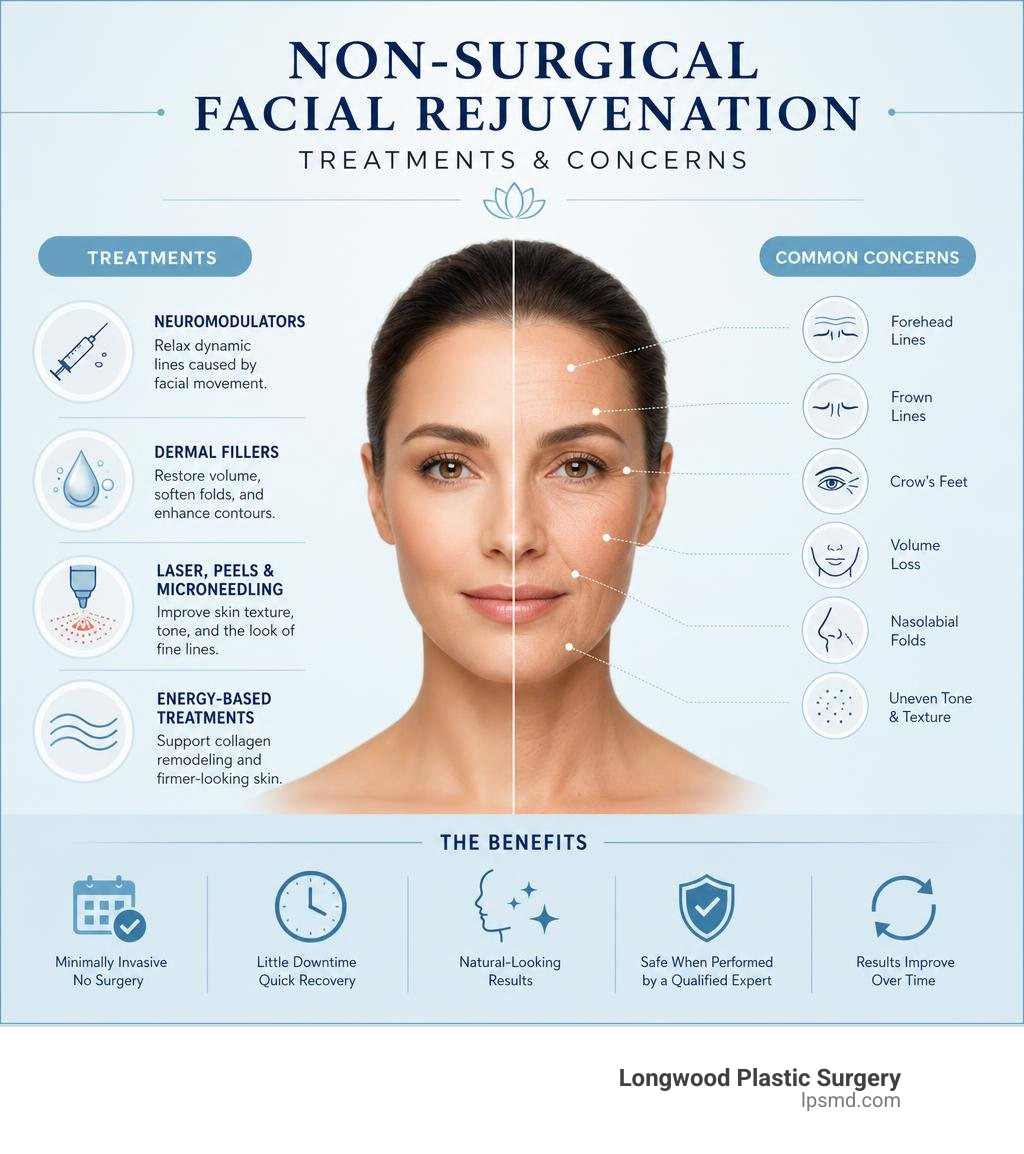
Non-surgical facial rejuvenation is a customized group of minimally invasive treatments that refresh the face without surgical incisions or a long recovery. It can soften expression lines, restore lost facial volume, improve skin texture and tone, and support firmer-looking skin.
Rather than trying to treat every concern with one procedure, a good plan targets the changes that matter most to you:
- Botox relaxes muscles that create lines such as crow’s feet and frown lines.
- Hyaluronic acid fillers replace volume in areas like the cheeks, lips, and smile lines.
- CO2 laser, chemical peels, and microneedling improve sun damage, fine lines, uneven tone, and texture.
- Energy-based treatments may support collagen remodeling and skin tightening when appropriate.
These treatments are often best for people with early to moderate signs of aging who want natural-looking improvement with little social downtime. Results are temporary and vary by treatment, so maintenance visits, daily sunscreen, and a consistent skin-care routine are important.
At Longwood Plastic Surgery, our board-certified plastic surgeons bring extensive training through Harvard-affiliated hospitals and decades of experience in facial aesthetic procedures. This guide explains how to compare options, set realistic goals, and make a safer, more confident choice.
For related reading, explore our guides to a facelift without surgery and facial rejuvenation without surgery.
How Non-Surgical Facial Rejuvenation Works
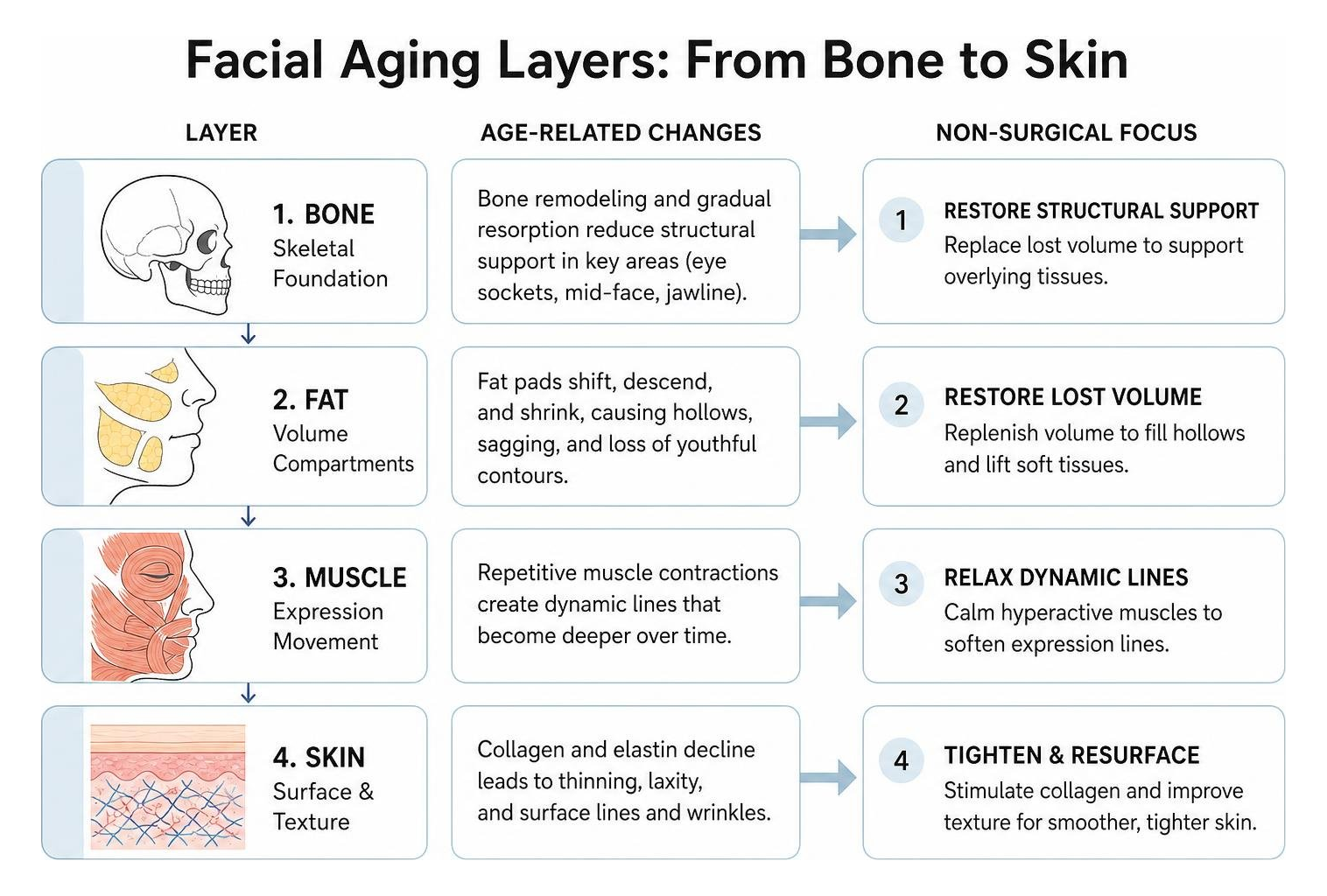
Facial aging does not happen in just one layer of tissue. Over time, skin loses elasticity, fat pads shift and shrink, facial muscles create repetitive creases, and the underlying skeletal framework gradually resorbs. A non-surgical approach addresses these distinct anatomical changes without general anesthesia or scalpel incisions (Li et al., 2022).
Instead of lifting and excising redundant tissue surgically, minimally invasive aesthetics focus on four core pillars: relaxing hyperactive muscles, restoring lost volume, tightening loose dermal tissue, and resurfacing the outer skin layers. By selecting targeted tools for each layer, we can create natural-looking balance and refreshed contours.
| Attribute | Surgical Facelift | Non-Surgical Facial Rejuvenation |
|---|---|---|
| Primary Goal | Reposition deep tissues and remove excess skin | Restore volume, relax dynamic lines, and improve texture |
| Anesthesia | General anesthesia or deep sedation | Topical numbing or local anesthesia |
| Incision Type | Carefully concealed surgical incisions | Tiny needle punctures or non-invasive energy delivery |
| Downtime | 2 to 4 weeks of social recovery | None to a few days depending on the procedure |
| Longevity | 10+ years | 3 months to 2 years (requires ongoing maintenance) |
| Best For | Moderate to severe laxity, jowls, and neck sagging | Mild to moderate skin laxity, fine lines, and early volume loss |
Non-Surgical Rejuvenation vs. a Surgical Facelift
A traditional surgical facelift (rhytidectomy) remains the gold standard for correcting significant tissue descent, deep jowls, and substantial skin laxity along the lower face and neck. During surgery, deep facial tissues (the SMAS layer) are elevated and resuspended, and excess skin is trimmed away.
In contrast, non-surgical alternatives provide subtle, targeted enhancements. Patients exploring non-surgical facelift options often want to address mild hollows or surface creases without the commitment of surgery. Non-surgical options cannot duplicate the dramatic lifting capacity of a surgical facelift, but they excel at early intervention, fine-tuning, and skin-quality restoration.
How Non-Surgical Rejuvenation Addresses Facial Aging
To understand how non-surgical treatments work, we must look at what happens beneath the surface:
- Collagen and Elastin Depletion: Starting in our twenties, structural protein production declines, leading to thinning skin and fine wrinkles.
- Fat Redistribution and Atrophy: Deep fat compartments in the temples, mid-face, and tear troughs gradually shrink, causing the skin above to sag and hollow.
- Dynamic Expression Lines: Decades of smiling, squinting, and frowning cause facial muscles to etch persistent creases into the overlying skin.
- Bone Remodeling: The facial skeleton loses subtle density around the eye sockets, jawline, and mid-face, reducing the foundational support for soft tissues.
According to scientific research on non-surgical modalities for facial aging, modern aesthetic techniques work synergistically by replacing structural volume, modulating muscle movement, and triggering fresh collagen synthesis (Li et al., 2022).
Primary Treatment Modalities for Non-Surgical Facial Enhancement

At Longwood Plastic Surgery, we offer a comprehensive suite of Non-Surgical Procedures designed to harmonize facial features. Combining treatments often delivers the most complete, balanced result.
Neuromodulators and Dermal Fillers for Wrinkle Relaxation and Volume Restoration
Injectables are the cornerstone of modern non-surgical rejuvenation:
- Neuromodulators: Injections such as Botox work by temporarily blocking acetylcholine release at the neuromuscular junction. This relaxes targeted dynamic muscles that cause forehead lines, frown lines, and crow’s feet. If you want to understand how different options perform, read our guide on how to Smooth Away Wrinkles: How Botox, Xeomin, and Jeuveau Work.
- Dermal Fillers: Formulated primarily from biocompatible substances like hyaluronic acid, soft-tissue fillers replenish depleted fat pads, sculpt cheekbones, define the jawline, and soften nasolabial folds. Discover more about our volumizing solutions with hyaluronic acid fillers. Hyaluronic acid also attracts water molecules, imparting a healthy, hydrated glow to the overlying skin.
Energy-Based Skin Tightening and Laser Resurfacing
Energy devices harness controlled thermal energy to stimulate neocollagenesis (the creation of new collagen fibers) deep within the dermis. An overview of non-surgical facelift options highlights how these technologies bridge the gap between topical skincare and surgical lifting:
- Fractional CO2 Laser Resurfacing: Vaporizes micro-columns of damaged skin while leaving surrounding tissue intact, prompting rapid healing, deep collagen contraction, and the clearance of stubborn pigmentation.
- Radiofrequency (RF) Technologies: Platforms such as IgniteRF deliver focused heat into the subdermal layers, tightening existing collagen matrices and triggering long-term tissue remodeling without disrupting the epidermal surface.
Chemical Peels and Microneedling for Skin Texture and Tone
Restoring skin quality is just as crucial as addressing volume and laxity:
- Chemical Peels: By applying medical-grade acidic solutions (such as glycolic, salicylic, or trichloroacetic acid), chemical peels remove dull, dead outer cell layers. Learn What Skin Conditions Can a Chemical Peel Improve? to see how peels target sun damage, hyperpigmentation, and rough tone.
- Microneedling: Using ultra-fine sterile needles, microneedling creates microscopic mechanical channels in the dermis. This controlled micro-injury activates the body’s natural wound-healing cascade, releasing growth factors that produce new collagen and elastin. If you are considering this treatment, find out How Long Does It Take to See Results from Microneedling? to plan your treatment schedule.
Ideal Candidates, Longevity, and Recovery Timelines
Understanding candidacy and recovery expectations ensures you achieve satisfying, realistic aesthetic outcomes.
Treatment Longevity and Maintenance Schedules
Because non-surgical treatments work with your body’s natural metabolic pathways, their effects are temporary:
- Neuromodulators (Botox): Typically last 3 to 4 months as motor nerve endings gradually regenerate new connections.
- Hyaluronic Acid Fillers: Usually maintain structural support for 6 to 18 months, depending on the product density and injection location.
- Laser Resurfacing and Microneedling: Produce long-lasting collagen improvements, though continued biological aging and sun exposure mean annual maintenance sessions are ideal.
If you are exploring a combined liquid approach, read our breakdown on How Long Does a Liquid Facelift Last? to understand how to preserve your refreshed look over time.
Candidacy, Safety Profiles, and Contraindications
Good candidates for non-surgical rejuvenation generally display mild to moderate skin laxity, dynamic expression wrinkles, or early facial volume loss. You might wonder, Am I a Good Candidate for a Liquid Facelift? If you prefer a treatment plan with minimal social downtime and gradual, natural-looking refinement, non-surgical therapies are an excellent match (Corduff, 2023).
Certain medical conditions require postponing or avoiding specific treatments:
- Active skin infections, open lesions, or cold sores in the treatment zone
- Pregnancy or breastfeeding
- Neuromuscular conditions (for neuromodulators)
- Severe, advanced skin laxity where surgical repositioning remains the appropriate clinical path
Explore our full catalog of Cosmetic Treatments to see how our team customizes plans to your unique medical profile.
Frequently Asked Questions About Non-Surgical Rejuvenation
Can non-surgical treatments replace a surgical facelift?
Non-surgical treatments cannot replicate the dramatic repositioning and longevity of a surgical facelift. While injectables and energy devices restore volume and improve skin tone, they cannot eliminate significant excess skin or heavily sagging jowls. However, non-surgical options serve as an outstanding preventive tool for younger patients, a maintenance strategy following prior surgery, or an alternative for those who prefer to avoid surgical recovery.
What is the typical recovery time after non-surgical procedures?
Recovery is remarkably brief. Neuromodulators and most filler injections allow you to return to normal daily activities immediately, with minor localized swelling or temporary pinprick redness resolving within hours to a few days. Light chemical peels and microneedling often cause 24 to 48 hours of mild pinkness, while fractional CO2 laser resurfacing may require 5 to 7 days of social downtime as the outer skin gently peels and heals.
How should I prepare my skin before undergoing treatment?
Optimizing your skin barrier enhances treatment outcomes (Commander et al., 2016). We recommend applying a broad-spectrum sunscreen daily (SPF 30 or higher) and staying well hydrated. Depending on the planned procedure, your provider may suggest pausing certain active topicals (such as retinoids or exfoliating acids) for a few days beforehand.
Conclusion
Non-surgical facial rejuvenation offers an effective, versatile way to refresh your features, smooth wrinkles, and restore lost volume without surgical recovery. By combining modalities like neuromodulators, dermal fillers, CO2 lasers, and microneedling, you can achieve balanced, radiant, and age-defying results tailored specifically to your goals.
At Longwood Plastic Surgery in Brookline, Massachusetts, our board-certified plastic surgeons bring over 50 years of combined aesthetic and reconstructive experience to every patient consultation. We believe in providing personalized, safe, and judgment-free care to help you look and feel your absolute best. Ready to discover your personalized treatment plan? Contact us today to explore non-surgical facial rejuvenation options and schedule your private consultation.
References
Li K, Meng F, Li YR, Tian Y, Chen H, Jia Q, Cai H, Jiang HB. “Application of Nonsurgical Modalities in Improving Facial Aging..” International journal of dentistry, 2022. PMCID PMC8894069. Corduff N. “Surgical or Nonsurgical Facial Rejuvenation: The Patients’ Choice..” Plastic and reconstructive surgery. Global open, 2023. PMCID PMC10550030. Commander SJ, Chang D, Fakhro A, Nigro MG, Lee EI. “Noninvasive Facial Rejuvenation. Part 1: Patient-Directed..” Seminars in plastic surgery, 2016. PMCID PMC4961507.


